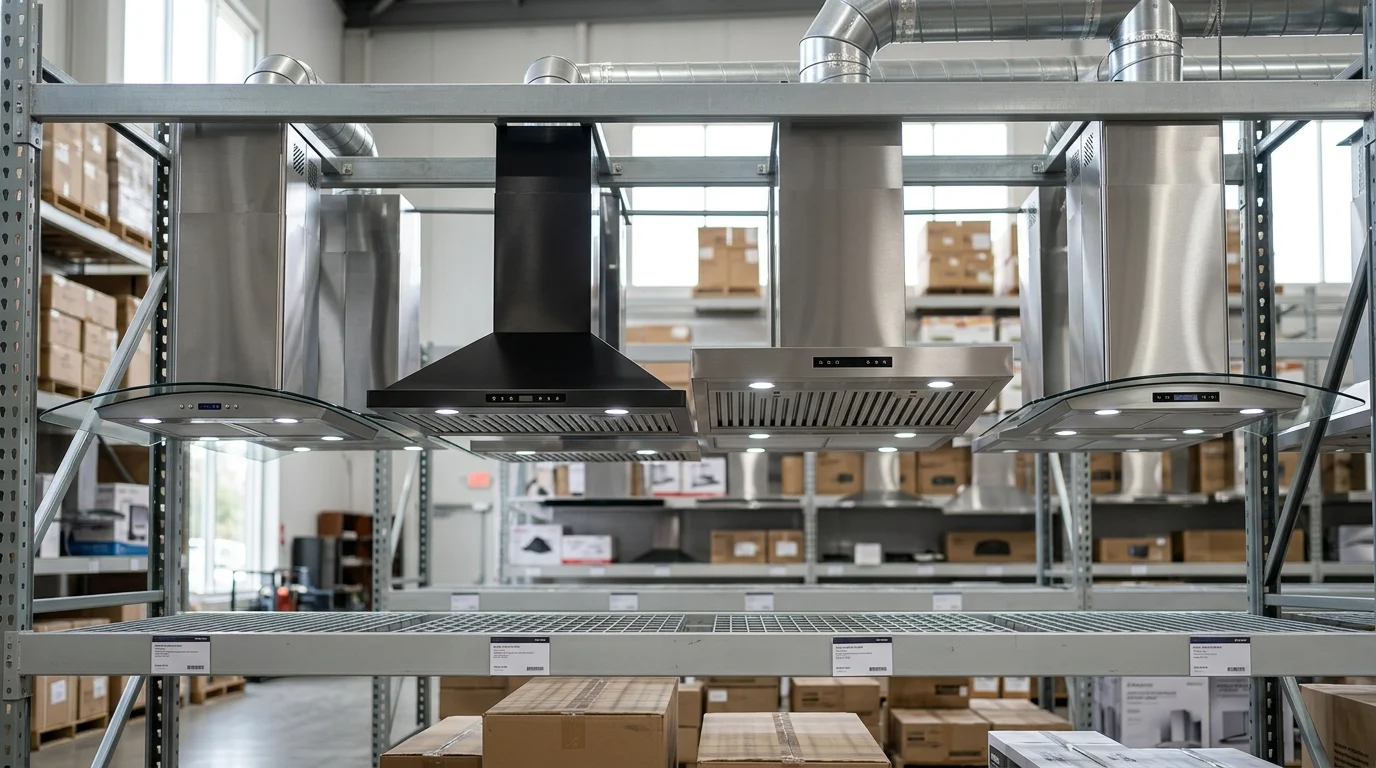
Why CFM Selection Matters for Wholesale Island Range Hoods
Wholesale island range hoods represent a premium segment in the kitchen appliance market, demanding rigorous technical evaluation from B2B buyers. Among the most critical specifications is the Cubic Feet per Minute (CFM) rating, which dictates the volume of air the hood can extract. For barbecue applications, where high heat, intense smoke, and heavy grease particulates are the norm, selecting the correct CFM tier is not merely a matter of feature padding—it is a fundamental requirement for product viability and long-term brand reputation.
Airflow Requirements and Product Positioning
The CFM capacity of an island range hood directly influences its market positioning and target demographic. Distributors and importers must align their procurement strategies with the specific needs of their sales channels. A standard residential island hood typically operates between 400 and 600 CFM, catering to everyday indoor cooking. However, when positioning products for indoor or covered outdoor BBQ setups, the baseline shifts dramatically.
Pro-style BBQ hoods require extraction rates starting at 900 CFM, with premium models reaching 1200 to 1500 CFM to handle the intense thermal output and smoke generation of commercial-grade burners. Buyers must categorize their wholesale portfolios accordingly to avoid under-speccing, which leads to high return rates and customer dissatisfaction, or over-speccing, which erodes margin competitiveness in entry-level markets.
BBQ Cooking Load and Grease Output
Barbecue grills generate significantly more heat and effluent than standard electric or induction cooktops. The industry standard calculation requires 100 CFM for every 10,000 British Thermal Units (BTUs) of burner output. Modern built-in BBQ grills frequently feature total outputs ranging from 60,000 to 90,000 BTUs.
Consequently, a wholesale island range hood paired with these appliances must deliver a minimum of 600 to 900 CFM just to manage the thermal load, before accounting for the heavy grease and smoke typical of grilling meats. Sourcing teams must ensure that the blowers integrated into their OEM/ODM orders are rated to sustain this extraction volume without overheating or suffering premature motor failure due to grease accumulation.
Installation Constraints and Performance Impact
Island range hoods face unique aerodynamic challenges that directly impact CFM requirements. Unlike wall-mounted hoods, which benefit from a physical barrier that guides the cooking plume into the capture area, island hoods are exposed to ambient cross-drafts from all four sides. This exposure diffuses the thermal plume, requiring a higher suction velocity to capture the effluent effectively.
B2B buyers should factor in a 20% to 30% CFM premium for island configurations compared to wall-mounted equivalents serving the same BTU load. Furthermore, installation height plays a crucial role; BBQ hoods are often mounted 36 to 42 inches above the cooking surface to accommodate larger grills and deeper pots, further necessitating a robust 1000+ CFM blower to bridge the increased vertical gap and maintain capture efficiency.
How B2B Buyers Calculate the Right CFM

Determining the optimal CFM for wholesale island range hoods requires procurement teams to move beyond theoretical maximums and evaluate real-world performance metrics. B2B buyers must implement strict calculation frameworks during the sourcing phase to ensure the products they import meet the technical demands of their target markets.
Technical Inputs Procurement Teams Should Request
When initiating inquiries with manufacturers, procurement teams must request specific technical inputs to validate CFM claims. Key data points include the blower’s free-air performance curve, the motor’s power consumption (measured in watts), and the static pressure rating at various operating speeds. Importers should also analyze the capture area of the hood canopy.
A high-CFM blower paired with a shallow or undersized canopy will result in poor capture efficiency, as the smoke will roll over the edges before it can be extracted. Buyers must mandate minimum depth specifications—typically 27 to 30 inches for BBQ applications—to complement extraction rates exceeding 900 CFM.
| Appliance Heat Output (Total BTUs) | Recommended Base CFM | Adjusted CFM for Island Setup (+25%) | Minimum Duct Diameter |
|---|---|---|---|
| Up to 40,000 BTUs | 400 CFM | 500 CFM | 6 inches |
| 40,000 – 60,000 BTUs | 600 CFM | 750 CFM | 8 inches |
| 60,000 – 90,000 BTUs | 900 CFM | 1125 CFM | 10 inches |
| 90,000+ BTUs | 1200+ CFM | 1500+ CFM | 10 – 12 inches |
Static Pressure, Blower Type, and Duct Configuration
The advertised CFM is typically measured in a free-air environment, but real-world ducting introduces static pressure that degrades airflow. B2B buyers must account for the duct configuration required in their target markets. Long duct runs, multiple elbows, and roof caps can introduce 0.1 to 0.4 inches of water column (in. w.c.) of static resistance.
To combat this, procurement teams sourcing high-CFM wholesale island range hoods should specify dual centrifugal blowers or specialized high-static-pressure motors. Additionally, transitioning from a standard 6-inch duct to an 8-inch or 10-inch duct is mandatory for hoods exceeding 900 CFM. This larger diameter maintains optimal air velocity while reducing turbulence-induced noise and operational strain on the motor.
CFM Comparison Criteria for Product Evaluation
Evaluating competing products requires standardizing the CFM comparison criteria. Manufacturers may manipulate figures by testing at different voltage levels or omitting the resistance of baffle filters. B2B buyers should require suppliers to provide third-party laboratory test reports, such as those adhering to AMCA (Air Movement and Control Association) or HVI (Home Ventilating Institute) standards.
Procurement contracts should stipulate the operating CFM at a standardized static pressure (e.g., 0.1 in. w.c.) rather than relying solely on the free-air maximum. This ensures apples-to-apples comparisons when evaluating supplier bids and protects the importer’s brand reputation from underperforming products in the field.
Which Product and Manufacturing Specifications to Verify
Translating CFM calculations into physical product specifications is a critical phase in the B2B sourcing cycle. Wholesale buyers must verify that the manufacturer’s engineering and production capabilities align with the mechanical demands of high-performance BBQ ventilation.
Motor Power, Noise Level, and Filtration
Upgrading a hood’s CFM inherently impacts its acoustic profile and filtration requirements. A major challenge in sourcing 1000+ CFM wholesale island range hoods is mitigating noise. Buyers should specify a maximum noise threshold, typically targeting under 7 Sones (or approximately 65 decibels) at maximum speed.
This acoustic control often requires transitioning from traditional AC motors to Brushless DC (BLDC) motors, which offer higher torque, variable speed control, and significantly quieter operation. Furthermore, high-velocity airflow demands commercial-grade stainless steel baffle filters rather than aluminum mesh, as mesh filters create excessive static pressure and clog rapidly under heavy BBQ grease loads.
OEM and ODM Requirements
Importers engaging in OEM and ODM partnerships must clearly define their performance expectations in the manufacturing contract. Customizing CFM outputs often involves tooling modifications for the blower housing and canopy structural reinforcements to prevent vibration under heavy loads.
B2B buyers should anticipate Minimum Order Quantities (MOQs) for highly customized blower configurations. While standard 600 CFM models might carry MOQs of 50 to 100 units, custom dual-blower 1200 CFM assemblies for ODM projects typically require MOQs of 200 to 500 units to offset the factory’s engineering and retooling costs. Clear specification sheets prevent scope creep and ensure the factory delivers the exact motor tier requested.
Factory Capability and Quality Consistency
The reliability of a wholesale island range hood hinges on the factory’s quality control consistency. Sourcing from established ventilation manufacturing hubs, such as Shengzhou in Zhejiang province, provides access to mature supply chains and specialized testing infrastructure.
Procurement teams must verify that the factory possesses in-house wind tunnel testing chambers to validate CFM output directly on the assembly line. A robust supplier should demonstrate a defect rate of less than 1.5% for motor and blower assemblies. B2B buyers are advised to implement AQL (Acceptable Quality Limit) inspections focusing on motor vibration, electrical safety under high load, and airflow consistency across production batches.
What Compliance, Logistics, and Cost Factors Influence CFM Decisions
Selecting a high-CFM specification does not occur in a vacuum; it triggers a cascade of compliance, logistical, and financial variables that procurement teams must manage. B2B buyers must weigh the performance benefits of powerful BBQ hoods against the tangible impacts on the broader supply chain.
Market Compliance Requirements
Regulatory compliance is the foremost hurdle when importing high-CFM ventilation equipment. In the North American market, the International Residential Code (IRC) mandates that any exhaust system capable of extracting more than 400 CFM must be paired with an automatic make-up air system.
Importers must decide whether to source 390 CFM models to bypass this regulation for the entry-level market or to explicitly market 900+ CFM models as professional-grade units requiring specialized HVAC installation. Additionally, high-power motors must carry appropriate electrical certifications, such as UL or cUL for North America and CE or RoHS for European markets, to ensure liability protection and smooth customs clearance.
Carton, Pallet, and Container Efficiency
The physical size of the blower required to achieve high CFM directly affects the dimensions of the range hood canopy and the chimney. This, in turn, impacts packaging volume and container loading efficiency. A wholesale island range hood equipped with a massive 1200 CFM dual blower requires a larger carton and thicker EPS foam to protect the heavier motor during transit.
This reduces the number of units that can fit into a standard shipping container, thereby increasing the landed cost per unit. Procurement teams must optimize carton dimensions with the supplier to maximize pallet density without compromising product safety.
| Hood Width & CFM Tier | Blower Configuration | Est. Carton Volume (CBM) | Units per 40HQ Container |
|---|---|---|---|
| 36-inch / 400 CFM | Single Centrifugal | 0.25 CBM | ~260 – 270 units |
| 36-inch / 900 CFM | Upgraded Single | 0.32 CBM | ~200 – 210 units |
| 42-inch / 1200 CFM | Dual Centrifugal | 0.45 CBM | ~140 – 150 units |
| 48-inch / 1500 CFM | Pro-Style Dual | 0.55 CBM | ~110 – 120 units |
Total Cost Comparison for Target CFM
B2B buyers must conduct a comprehensive Total Cost of Ownership (TCO) analysis when selecting CFM tiers. Upgrading a base model from 600 CFM to a 1200 CFM specification typically adds $40 to $80 to the Free On Board (FOB) factory price due to the cost of larger copper-wound motors, reinforced steel, and upgraded electronics.
However, this increased Bill of Materials (BOM) cost must be weighed against the potential retail margin. Premium BBQ hoods with verified high-CFM capabilities can command a $200 to $400 premium in wholesale and distribution channels. Buyers must balance the higher freight costs and initial capital outlay against the expanded profit margins available in the luxury outdoor kitchen sector.
How Procurement Teams Build a Reliable Buying Decision
Establishing a reliable procurement pipeline for wholesale island range hoods requires moving beyond single-spec evaluations to build comprehensive supplier relationships and strategic product assortments. B2B teams must synthesize technical CFM requirements with their broader market objectives.
Supplier Evaluation from Inquiry to Approval
The supplier evaluation process must rigorously test a manufacturer’s claims from the initial inquiry through to final approval. B2B buyers should initiate the process by requesting detailed spec sheets and component breakdowns for the ventilation units. Following the initial technical vetting, ordering a sample is mandatory.
During sample evaluation, procurement teams should utilize anemometers to verify airflow velocity at the baffle filters and sound meters to check noise levels against the factory’s Sone ratings. Furthermore, buyers should audit the supplier’s ISO 9001 certification and assess their production lead times—typically 30 to 45 days for standard orders—to ensure they can scale up production for seasonal BBQ market peaks without compromising motor quality.
Matching CFM Tiers to Channel Strategy
Successful B2B importers rarely rely on a single CFM specification; instead, they develop a tiered channel strategy. A Good, Better, Best product matrix allows distributors to capture multiple market segments without cannibalizing their own sales.
The entry tier might feature 400 to 600 CFM models designed for multi-family developments or entry-level island setups where make-up air regulations are a constraint. The mid-tier, featuring 800 to 900 CFM, serves the core residential upgrade market. Finally, the premium tier, boasting 1200+ CFM dual-blower systems, is targeted exclusively at specialty retailers and contractors building custom outdoor BBQ kitchens. By aligning specific CFM capabilities with distinct distribution channels, procurement teams can optimize their inventory turnover, maximize profitability, and establish a dominant presence in the wholesale ventilation market.
FAQ
How much CFM should a wholesale island BBQ hood have?
Match airflow to grill output: about 100 CFM per 10,000 BTUs, then add 20% to 30% for island installation. Most BBQ island models need roughly 900 to 1200+ CFM.
Why do island range hoods need more CFM than wall-mounted models?
Island hoods face cross-drafts from all sides, so smoke spreads faster. A practical rule is to specify 20% to 30% more CFM than a wall hood for the same grill load.
What technical data should buyers request from Jilu Kitchen before ordering?
Ask for the blower performance curve, static pressure data, motor wattage, duct size recommendation, and canopy dimensions. For BBQ use, confirm a deeper canopy, typically around 27 to 30 inches.
What hood depth is recommended for BBQ island applications?
Choose a canopy depth of about 27 to 30 inches for better smoke capture. High CFM alone is not enough if the hood is too shallow for heavy grease and grill smoke.
Can a 600 CFM island hood work for a built-in BBQ grill?
Usually only for smaller grills around 40,000 to 60,000 BTUs. For most built-in BBQ setups, buyers should move toward 900 CFM or higher, especially with taller mounting heights.